WHAT'S NEW?
Loading...
Showing posts with label News. Show all posts

EDGE Memory’s diskGO Pocket USB 3.0 SSD Offers Storage On The Go


Users who travel and need to transfer large amounts of data from place to place may want to check out EDGE Memory’s new portable storage product, the diskGO Pocket USB 3.0 SSD. Smaller than a credit card, the DiskGO Pocket is one of the smallest SSD-based storage products on the market. Equipped with a SandForce controller and able to transfer data at USB 3.0 speeds (up to 10x faster than USB 2.0), the DiskGO Pocket’s mSATA solid-state drive comes in three storage capacities: 60GB, 120GB, and 240GB. Note that if you just want to take an mSATA SSD you already own and turn it into an external storage device to add space to UltraBooks or other systems, you can get a separate diskGO Pocket enclosure and use it with your existing SSD.

GIGABYTE Radeon R9 270 Overclock Edition


If you find most versions of the R9, AMD’s new flagship GPU line code-named “Hawaii,” roo rich for your budget, but you crave Big Red’s cards, you’re probably going to love the R9 270. The 270 is AMD’s most affordable member of the R9 family, and for under $200 it’s in a sweet spot in terms of affordability and power. GIGABYTE’s take on the GPU, the Radeon R9 270 Overclock Edition, squeezes out additional performance by overclocking the GPU to 950MHz (975MHz Boost) and adding the WINDFORCE 2X cooling system. The system includes dual 100mm fans tied to pure copper heat pipes to dissipate heat and provide powerful airflow. The $179.99 card ships with GIGABYTE OC GURU II overclocking software and 2GB of GDDR5 memory, and it requires a 500W power supply.

Measure Twice, Cut Once (Or Twice)


Advertising firm Barkley out of Kansas City, Mo., must be looking forward to winter. The company has the usual corporate website, but for at least a couple of years now it also has had a separate “Make-a-Flake” site at snowflakes.barkleyus.comwhere you can take a pair of on-screen scissors and cut up virtual snowflakes to your heart’s content. After making your flakes, you can post them to the site’s gallery. 


You also can download JPEGs of them that you can save or print (or, if you’re more ambitious, you can download editable EPS versions that you can use in other design programs like PhotoShop). Is it true no two snowflakes are alike? Well, just try to make the same flake two times in a row (yeah, we dare you). Evidently some people have tried to make some other rather . . . uh, unique designs, because the site includes a report option in case you run across “offensive” snowflakes. Stay classy!

DropCam Pro With Cloud Recording


DropCam (the company) has an updated version of DropCam (the camera). The new DropCam Pro is a dual-band Wi-Fi video camera that includes two-way audio, 8X digital zoom, night vision, and intelligent alerts (receive notifications via email or text). The lens of the camera has a 130-degree field of view, so you can capture an entire room and then zoom in remotely if you want to see something in detail. (Baby crib, anyone?) An optional subscription-based service saves either the last seven days or 30 days of your video to the cloud, letting you review the video later at your leisure. 


You can even clip and save sections of video to your desktop or share links to saved clips with friends. The Cloud Recording service for one camera runs $99/year for seven days of video storage and $299/year for 30 days; there is a 50% discount for Cloud Recording that you add to additional cameras. The camera itself retails for $199.

Net In Every House & VideoEnabled Devices In Every Pot


Research firm IHS is forecasting there will be more than 8 billion video-enabled devices online in 2017, which will exceed the total human population of the earth at that time (expected to reach 7.4 billion). Currently there are about 4.3 billion tablets, smart TVs, smartphones, Blu-ray players, PCs, gaming consoles, and so on that are connected to the Internet, but IHS says that number is growing much more rapidly than the population of homo sapiens. 


Although PCs represented 93% of all connected devices less than 10 years ago, in 2017 their share will be only 23%. SmartTVs will have 5%, gaming consoles 2%, and smartphones and tablets will represent the lion’s share at 67%.

Put Some Coder On That Pi


Googler Jason Striegel, a member of the Google Creative Lab crew, has released a nifty bit of open-source code that he calls “Coder” that can turn a Raspberry Pi into a personal web server and development tool. Striegel says he embarked on the project with design friend Jeff Baxter and others as a way to help new coders learn how to program for the web. Now you can use Pi as the environment for experimenting with Javascript, HTML, CSS, and the like. 

To learn more about how Coder works and download the free program, go to: googlecreativelab.github.io/coder. You’ll also find links there to other items you may need (a Raspberry Pi, a Wi-Fi module, a power supply, and so on). Now you know what to get that hard-to-buy-for budding coder on your gift list.

TotalRecovery Tools Fixes Glitches


TotalRecovery Tools from FarStone Technology is a backup utility suite that includes disk imaging and other tools to clone hard drives and SSDs, browse files and rescue data, shred data, recover passwords, and otherwise manage the data on your PC from outside of the Windows environment. The suite requires no installation as it runs from a self-booting thumb drive or DVD. 


Running outside of Windows allows you to configure boot options, check OS errors, partition drives, and rescue data if your system crashes. The suite includes an Emergency Rescuer utility for crashed systems as well as a Universal Restore utility. FarStone says using TotalRecovery Tools saves time and leaves no footprints when systems crash and need to be restored. The suite sells for $79.99; see www.farstone.com/software/totalrecovery-tools.php.

Release Your Inner Van Gogh


With Alien Skin’s Snap Art 4Have an artist’s eye but no dexterity with a paintbrush? Snap Art 4 is a program that can apply painting and drawing techniques to a photo and make it look handcrafted. The software can mimic the looks of different media—water color, oil, pencil sketch, crayon—and instantly transform a photo into a work of art. Snap Art 4 integrates with other well-known photo tools (Photoshop, Aperture) or can work as a standalone application. 


Alien Skin says it has reworked the user interface in Snap Art 4 to make it even more intuitive and easy to use than earlier versions. Current owners of Snap Art can upgrade for $69, otherwise the program sells for $99 at www.alienskin.com. (NOTE: The graphic shown here is from an earlier version as the new UI was still being tweaked as we went to press.)

Personal Cloud NAS From Shuttle


Smaller form factor computer pioneer Shuttle announced it has a new NAS product for small-office or home user types who want an easy way to store, access, and share different types of data. The OMNINAS KD20 is a two-bay network-attached storage device that Shuttle designed to be a multimedia content hub, a place where people can store home movies, photos, and music, or even documents for their small business. 

The KD20 makes it easy to then share those files with others, even if they are uploading or dowloading to/from an Android or iOS device. The KD20 also can act as a print server and a streaming content server, so you can store your audio and video files in one place and then watch or listen to your files through other devices such as game consoles or your TV. The bays can support up to two 4TB drives as JBOD, RAID 0, or RAID 1.

Valve’s Gameplan Picks Up Steam


Valve has big plans for your gaming entertainment, and they include playing games on a wide range of devices from multiple manufacturers that fall loosely under a spec the company is creating for something called the “Steam Machine.” Valve says consumers will see Steam Machines from several manufacturers next year, and it is collecting entries for a beta program where 300 lucky individuals will receive prototypes and be asked for their input on creating the final specs for retail products. 


Also on tap for gamers is a new type of input device for the boxes that Valve is calling the Steam Controller. The new gaming device uses dual trackpads in place of the usual analog thumbsticks, and the company says they offer a “higher-fidelity” gaming experience. (NOTE: For more information, see “Valve Opens The Floodgates” in this issue.)

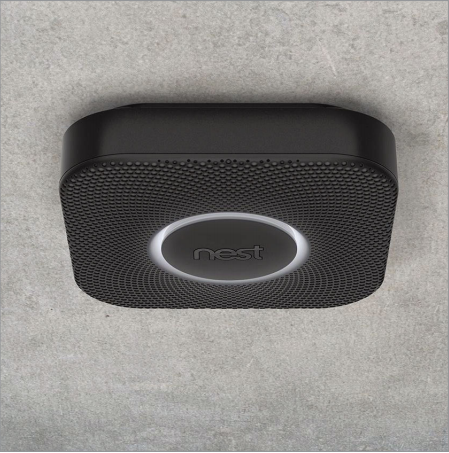
Nest Protect Rethinks Home Safety


The original Nest Thermostat woke up a sleepy home improvement category, and now the company is grabbing attention again with its new combo fire alarm and carbon monoxide detector. The Nest Protect shows what can happen when smart engineers and designers rethink how products should work. Instead of being standalone devices, Protect alarms communicate with each other as well as with Nest thermostats. For example, if Protect detects a high level of carbon monoxide, it notifies Nest to turn off the home furnace until the source can be identified. If an alarm goes off in one area of the home, Protect wakes up its brethren to ensure everyone is warned in time to get to safety. 


And in a truly brilliant move, Nest Labs put an early warning system called “Heads Up” into Protect, so that the alarm will tell you, in a human voice, if it detects smoke (and where). Then if it turns out to be a false alarm—maybe your significant other burned the meat loaf again—you can simply wave at Protect to turn off the alert before the sirens start.

Corsair Is Back In Black


If you need a roomy full tower for your next build, check out Corsair’s new Obsidian Series 750D ($159.99). The brushed aluminum and steel case has plenty of space for all the latest component goodness you want to add to your system. In addition to tool-less side panels and drive bays, and you’ll find little extras like cable routing grommets that will keep your wires safe and secure as you piece together your build. 


The case comes with three 140mm fans (two front, one rear), but has room for up to eight, and there are easy-access dust filters at the top, rear, and front. Included are six internal 3.5/2.5-inch bays in two modular cages, and you can add up to four more SSDs via dedicated sideways-oriented mounts. The case’s nine expansion slots mean SLI and CrossFireX configs are no problem, and the front panel has four USB ports (two USB 3.0) and headphone/mic jacks. Dimensions are 22 x 9.25 x 21.5 inches (HxWxD); weight is 21.4 pounds.

CyberPowerPC Adds HX6 Series To Fangbook EVO Notebook Line 


CyberPowerPC has announced three powerful new notebooks that are available under the series name Fangbook EVO HX6. The HX6 100 has a Core i7-4700MQ processor, 8GB of DDR3L 1600MHz system memory, and a 1TB SATA300 HDD. The HX6 200 has the same processor but steps up to 16GB of DDR3 1600MHz memory, and it comes with a 64GB SanDisk SSD. The HX6 300 has an i7-4900MQ processor, 16GB of DDR3 1600MHz memory, a 60GB Intel SSD, and a 1TB SATA300 HD. 


All three systems sport an NVIDIA GTX765M with 2GB of graphics memory, as well as a true HD (1,920 x 1,080) 15.6-inch LED-backlit screen. Systems in the HX6 series come with Windows 8.1, and they all offer Matrix Multi Display capabilities, so you can run up to three screens including the notebook display when you want to really put yourself in the middle of all the action. Prices start at $1,019.

OCZ’s PSUs Have Looks That Kill


The latest refreshes in the OCZ Fatal1ty line of PSUs are now available at retail. OCZ first announced the new 550W and 750W models at Computex in June. Priced at $79.99 and $109.99, they are partof an ongoing collaboration with world champion gamer Jonathan “Fatal1ty” Wendell to produce power supplies tailored to the needs of enthusiasts. Both of the new PSUs have 80-Plus Bronze efficiency ratings, come with single +12V rails, and are built to last with premium components. 


They also feature load and temperature controlled 135mm fans with LEDs that glow the signature red of the Fatal1ty line. Modders will enjoy the flexibility afforded by the modular cabling system, too, as the PSUs come with a full assortment of connectors and cabling that lets system builders select only the wiring they need for their particular rigs.

Archos Ups The Ante With GamePad 2


Archos is beefing up its original GamePad handheld gaming system with an HD screen, larger battery, and more powerful processor. The second-generation GamePad 2 also ditches the multiple directional buttons—something that was roundly criticized on the original model—in favor of a single directional control that the company says offers a better gaming experience. 


The new system will be powered by a 1.6GHz quad-core A9 generation processor and 2GB of RAM. Two versions will be available, one with 8GB of storage and one with 16GB, and a microSD slot is once again included that can add up to 64GB more. GamePad 2 is a tablet as well as a gaming device and runs the Android 4.2 Jelly Bean operating system. The GamePad 2 is priced at $199.99 and should be in full launch mode by the time you read this.

MSI Announces GP Notebooks


The holiday season is on us, so you might as well ask Santa now for that new system you’ve been wanting – maybe one of the new GP series laptops by MSI would make you happy? The three laptops in the series were designed with gamers in mind, offering 8GB of DDR3L 1600MHz system memory and NVIDIA’s GeForce GT740M with 2GB of GDDR3 video RAM. 


Two of the models have an Intel Core i5-4200M processor, but one has a 16-inch screen (resolution 1,366 x 768) and a 750GB HD, while the other has a 17-inch screen (resolution 1,600 x 900) and 1TB HD. The third model in the series also offers a 16-inch screen (with a resolution of 1,920 x 1,080) and 750GB HD, plus it sports a Core i7-4700MQ and a more powerful battery. All systems come with Windows 7 Home Premium as the OS; prices start at $899.99.